I’ve been meaning to share about this work for a while. I feel like I had so many projects on my plate that some never got the attention they deserved. This work emerged from the ASU ShapingEDU Pente Pitch Challenge, a Shark Tank-style online competition where five Action Teams developed project charters and pitched proposed outputs for funding. Teams worked around five Calls to Action addressing Digital Belonging, Humanizing Learning, Emerging Credentials, the Evolving New Now, and Data-Driven Learning Futures. I was part of the team focused on Data-Driven Learning Futures and began asking how we might rethink the way students make decisions about college by looking beyond traditional measures of cost, graduation, and earnings, as represented in the college scorecard or U.S. News World and Report, to better understand what students value and need from higher education.
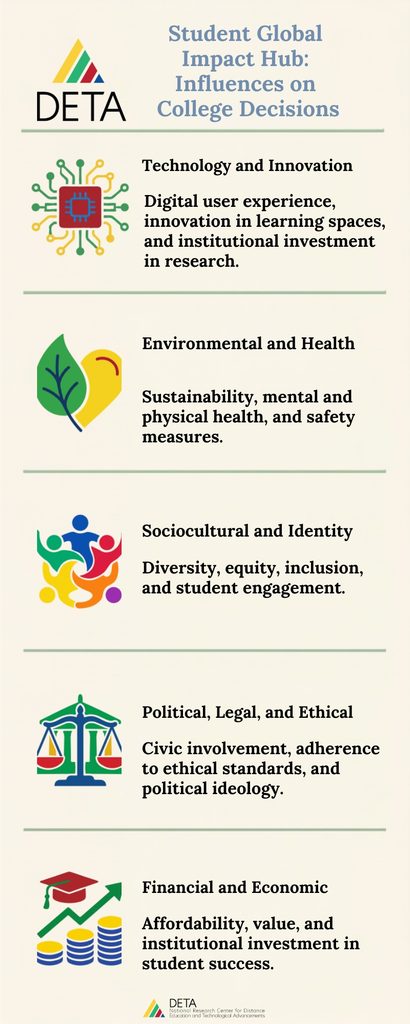
The resulting Student Global Initiative (SGI) Hub was designed as a framework and platform for considering non-traditional, human, and social outcomes alongside traditional economic measures. Recognizing that today’s students are making decisions within a changing social, economic, environmental, political, and technological landscape, we developed a student-centered framework organized around five interconnected areas: economic and financial; environmental, health, and safety; social, sociocultural, and identity; technology and innovation; and political, legal, and ethical factors.
Drawing from research, existing college rating systems, public data and media, and student survey data, the work shifts the question from simply whether college produces an economic return to how institutions create value for students more broadly, including their personal growth, health and well-being, sense of belonging, opportunities to engage and connect, ability to participate in an increasingly technological world, and capacity to contribute to their communities and society.
Ultimately, the framework offers a more holistic way to think about institutional value and student decision making, and begins to identify measures that could help institutions better understand, communicate, and improve the experiences and outcomes that matter to students. There is more to higher ed than economic value.
Just to give you a bit of an introduction, using systems thinking in approaching students in higher ed, we were able to identify 5 areas using a grounded approach in analyzing the data and information that we had collected. Within each of those areas, we identified the primary focus or defining factors. More over, we developed key considerations for institutions in providing value to students.
Five Primary Areas of Influence on College Decision-Making
Title:
Five Primary Areas Influencing College Decisions
- Technology and Innovation:
- Focus Areas: Digital user experience, innovation in learning spaces, and institutional investment in research.
- Key Considerations: Ease of application, accessibility, and support for innovative student research.
- Environmental and Health:
- Focus Areas: Sustainability, mental and physical health, and safety measures.
- Key Considerations: Environmental sustainability policies, student involvement in environmental activities, and the availability of health and safety services.
- Sociocultural and Identity:
- Focus Areas: Diversity, equity, inclusion, and student engagement.
- Key Considerations: Institutional commitment to inclusivity, cultural and demographic representation, and support for underrepresented groups.
- Political, Legal, and Ethical:
- Focus Areas: Civic involvement, adherence to ethical standards, and political ideology.
- Key Considerations: Student engagement in civic duties, political inclusivity, and institutional responses to legal and ethical issues.
- Economic and Financial:
- Focus Areas: Affordability, value, and institutional investment in student success.
- Key Considerations: Costs of attendance, financial aid availability, and the long-term economic benefits of attending a particular institution.